
Genesis
Exodus
Leviticus
Numbers
Deuteronomy
Joshua
Judges
Ruth
1 Samuel
2 Samuel
1 Kings
2 Kings
1 Chronicles
2 Chronicles
Ezra
Nehemiah
Esther
Job
Psalms
Proverbs
Ecclesiastes
Song of Solomon
Isaiah
Jeremiah
Lamentations
Ezekiel
Daniel
Hosea
Joel
Amos
Obadiah
Jonah
Micah
Nahum
Habakkuk
Zephaniah
Haggai
Zechariah
Malachi
HOLY BIBLE
BOOK OF GENESIS
GENESIS 9
1And God blessed Noah and his sons, and said to them, Be fruitful and multiply, and fill the earth.
2The fear of you and the dread of you shall be on all the animals of the earth, and on every bird of the sky, on all that move on the earth, and upon all the fish of the sea. They are given into your hand.
3Every moving thing that lives shall be food for you. Just as I gave you the green plant, I now give you all things.
4But you must not eat flesh with its life, that is, its blood.
5For your own lifeblood I will surely require a reckoning; from every beast I will require it, and from the hand of man. From the hand of every man's brother will I require the life of man.
6Whosoever sheds man's blood, by man his blood shall be shed; for in the image of God was man made.
7As for you, be fruitful and multiply; multiply upon the earth and fill it.
8Then God spoke to Noah and to his sons with him, saying,
9I now establish My covenant with you, and with your offspring after you;
10And with every living creature that is with you, of the birds, of the livestock, and of every animal of the earth with you; from all that have come out of the ark, every living thing on earth.
11I will establish My covenant with you; never again shall all flesh be cut off by the waters of a flood; never again will a flood destroy the earth.
12And God said, This is the sign of the covenant that I make between Me and you, and every living creature with you, for all future generations:
13I have set My rainbow in the cloud, and it shall serve as a sign of the covenant between Me and the earth.
14Whenever I bring clouds over the earth, and the rainbow appears in the clouds,
15I will remember My covenant that is between Me and you, and every living creature of all flesh. Never again will the waters become a flood to destroy all flesh.
16When the rainbow is in the clouds; I will see it and remember the everlasting covenant between God and every living creature of all flesh that is on the earth.
17Then God said to Noah, This is the sign of the covenant which I have established between me and all flesh that is on the earth.
18The sons of Noah who came out of the ark were, Shem, Ham, and Japheth. Ham was the father of Canaan.
19These are the three sons of Noah, and from them the whole earth was peopled.
20And Noah, a man of the soil, began and planted a vineyard.
21He drank of the wine, and was drunk; and he lay uncovered in his tent.
22And Ham, the father of Canaan, saw the nakedness of his father and told his two brothers outside.
23So Shem and Japheth took a garment and laid it on both their shoulders. Then they went in backwards, covering the nakedness of their father. Their faces were turned away so they did not see their father's nakedness.
24When Noah awoke from his wine, and learned what his younger son had done to him,
25He said, Cursed be Canaan; the lowest of servants he shall be to his brethren.
26And he said, Blessed by the LORD my God be Shem; and let Canaan be his servant.
27May God enlarge Japheth, and let him dwell in the tents of Shem; and let Canaan become his servant.
28After the flood Noah lived three hundred and fifty years.
29So all the days of Noah were nine hundred and fifty years: and he died.
This is the Bible Overview
View Commentaries for Genesis Chapter 1
The Stories of the Bible – Read here
"Charity suffereth long, and is kind; charity envieth not; charity vaunteth not itself, is not puffed up,"
- 1 Corinthians 13:4
Bible Related Topics
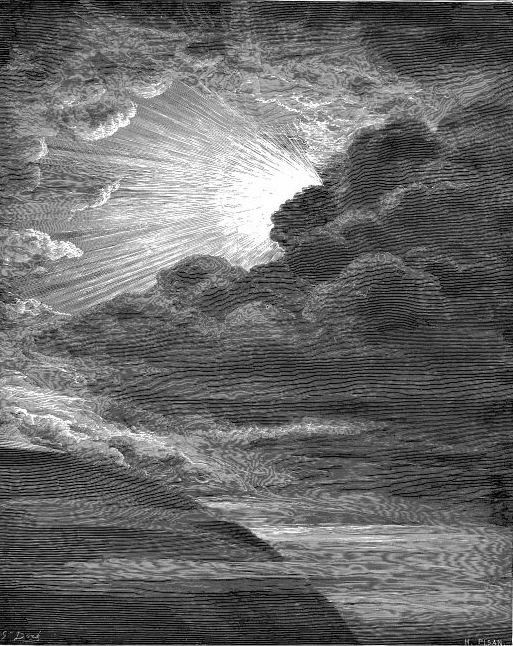
- St. Basil the Great – Hexaemeron (Orthodox, 4th century)
- Description: Nine homilies on the six days of creation (Genesis 1:1-31), exploring both literal and spiritual meanings. Basil emphasizes God’s omnipotence, the instantaneous nature of creation, and the cosmos’s order, integrating philosophical insights with Scripture.
- Relevance: A foundational Orthodox text, ideal for your site’s authoritative exegesis.
- Source: Available in English via Fathers of the Church series (Catholic University of America Press) or CCEL.org (public domain).
- St. Ambrose of Milan – Hexaemeron (Catholic, 4th century)
- Description: Six sermons on the creation days, heavily influenced by St. Basil but adapted for a Latin audience. Ambrose blends literal and allegorical interpretations, focusing on God’s providence and creation’s harmony.
- Relevance: A key Catholic commentary, complementing Orthodox perspectives.
- Source: Public domain, available via NewAdvent.org or Fathers of the Church series.
- St. Ephrem the Syrian – Commentary on Genesis (Orthodox/Catholic, Syriac tradition, 4th century)
- Description: A verse-by-verse exegesis of Genesis, including Genesis 1, with a focus on literal interpretation and Syriac theological traditions. Ephrem’s concise style emphasizes doctrinal fidelity and spiritual insights.
- Relevance: Bridges Catholic and Orthodox traditions, ideal for your Septuagint-based focus.
- Source: Translated in St. Ephrem the Syrian: Selected Prose Works (Catholic University of America Press).
- St. Augustine of Hippo – The Literal Meaning of Genesis (Catholic, early 5th century)
- Description: Augustine’s detailed commentary explores literal and allegorical readings, proposing that the “days” of Genesis 1 may be instantaneous or symbolic, reflecting God’s eternal act. It addresses creation’s purpose and God’s eternity.
- Relevance: A cornerstone of Catholic exegesis, offering intellectual depth.
- Source: Public domain, available via NewAdvent.org or Works of St. Augustine.
- St. John Chrysostom – Homilies on Genesis (Orthodox, 4th century)
- Description: A series of 67 homilies, with several covering Genesis 1, focusing on literal interpretation and moral/spiritual lessons. Chrysostom’s pastoral style makes the text accessible yet profound.
- Relevance: Widely respected in Orthodox tradition, suitable for lay readers.
Melchizedek Order
Educational Tools
Quick Links
Get In Touch
123 Main Street
New York, NY 10001
- Email: contact@mysite.com
- Phone: 123-456-7890
- Hours: Mon-Fri 9:00AM - 5:00PM
© 2026 All Rights Reserved.